
USAfricaonline.comhas been listed among theworld's leading
web sites by the international newspaper, USAToday.

Africa's Priorities in the 21stCentury:
The Economic and Social Necessity for Broadband
By G. ALFRED KENNEDY
Exclusive and Special to USAfrica The Newspaper, Houston
USAfricaonline.com,The BlackBusiness Journal and NigeriaCentral.com
This is part of the USAfricaonline.com policy series on Africa'spriorities into the 21st century. Archiving or republishing on anyother media site is not authorized except with the written permissionof USAfricaonline.com Founder
The evolution of African politics during the latter part of the20th Century tells me that Africa's priorities must be establishedand agreed upon by Africans. For any region still grappling withlegacies of colonialism, that have urban and rural populations intransition, with uneven infrastructure development, and limited by19th Century communications systems, it is a daunting challenge notonly to establish priorities, but to match essential priorities withavailable resources, to manage expectations for change, and, todevelop coherent strategies for growth that pass muster at home whilesatisfying potential investors and multilateral lending institutions.So, where does one begin without sounding prescriptive, an approachAfricans have come to expect from most observers of Africa. I willnot offer a list of priorities; this is already well-mappedterritory.
 Withall of the continent's needs, a major priority for Africa in the 21stCentury stems from the need to increase the ability of each country'spolitical and business leadership to improve communications betweencountries and improve internal communications between and amongwidely dispersed populations. The African government that can improvethe efficiency by which it communicates policy priorities, ideas andsuccesses to both its urban and rural populations is the governmentat the outer edge of the efficiency curve; the government most likelyto forge national consensus on critical issues. Deploying broadbandtechnology with high-speed access increases the pace of change andthe likelihood of success: bringing economies together, by creatingjobs, and by bringing skills to workers in all regions across acountry, all at the grassroots level.
The communications revolution going on in much of the rest of theworld could have an even greater impact on Africa because of theuneven flow of investment capital to Africa as opposed to Pacific Rimeconomies, for example. The impact could well be that Africa fallseven further behind its Middle Eastern neighbors
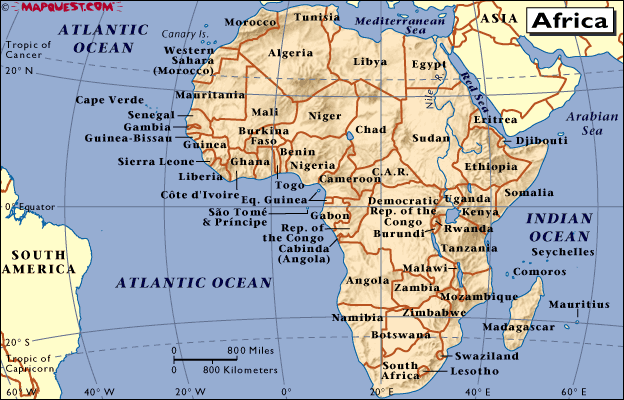
and some of Asia's more dynamic countries simply because of thesecountries' ability to attract foreign capital, technology, andskilled personnel. Africa just may continue to play "catch up" wellinto the 21st Century unless its business and political leadershipcan unite their populations behind growth and development strategiesthat meet basic needs not just for those that inhabit theirmetropoles but, also, for those isolated from urban centers.
Leadership has the obligation to create opportunities forself-help among those flocking to cities in search of employment,housing, education, and a brighter future. Adopting ahigh-efficiency, low cost, broadband technology enables entirecommunities, organizations, and institutions on the African Continentto communicate, share ideas, and, modernize educational, farming, andhealth-care systems. Therefore, new and affordable broadbandtechnologies must be included in the national development "toolbox".I suspect this achievement could serve as an incentive to overcome anunwillingness to risk investment capital in much of sub-SaharanAfrica.
Developments in communications are changing the world and thepossibilities everyone now has to communicate with anyone at anytimein even the most isolated locations. CNN brought the universe to thevillage. Broadband means the village can now communicate with thatuniverse. The possibilities for enlightened political leadershipthroughout the African Continent and its partners in the businesscommunity to communicate policies that advance the economic andsocial enrichment of underserved populations, and that seek toconnect rural populations to urban centers and to the world of 21stCentury communications, are enormous. African governments have a roleto play in deploying broadband. The local business community alsoneeds to step up as it does with other infrastructure development:railroads, highways, electricity, and basic telephone service.
Technology currently exists that provides bandwidthcapabilities to most transport infrastructures including theuniversally-deployed twisted pair copper wiring. For those regionsthat cannot afford to invest in costly fiber-optic cable, the mosteffective and cost-efficient solution is copper wiring deployed inmost structures around the globe today. This 19th Century relic iscapable of serving as a platform to solve 21st Century problems. Newbroadband technologies have overcome the difficulties associated withthe last mile: copper telephone wires that connect individual homesand small businesses to the broadband backbone. There is no longerthe need to lay a second line from the backbone to the customer.These new technologies would permit political, civic, and businessleaders at both the national and local levels to bridge the digitaldivide.
The result would be universal access to essential information toaddress the myriad issues that create, among other phenomena,mobility among underserved populations and, that create levels ofsocial instability abhorred by international lenders and investors.Bridging the digital divide through universal access could haveenormous beneficial implications for Africa in the 21st Century,particularly if the investment to achieve this goal is affordable.Accessible, affordable broadband is a resource crucial to theeconomic development of African societies.
With broadband, small business in both urban and rural areas areable to boost productivity; medical (tele-medicine) and educationalinstruction (distance learning) and treatment are now possible withreal-time, visual interaction, and government policies, priorities,and successes are now more easily shared with dispersed populationsfrom a desktop, a remote location, or from the home. The technologyoffers the option of "virtual presence" by integrating voice, video,and high-speed data at speeds unheard of in most Africansocieties.
This in itself would represent an affordable quantum leap into the21st Century. Both the political and the business leadership in manyof Africa's societies must acknowledge that an ambitious - yetaffordable - broadband strategy can help revitalize nationaleconomies, promote national unity, bridge the digital divide, andposition their economies to compete for investment capital.
The mantra for the 21st Century has to be that the Continent canno longer afford to drift; it is too large, has too many poor peopleand it has too many social problems. Deploying broadband technologycould lead to faster growth and expanded trade and investment withthe rest of the world. The question is, is there the political willto do so?
Kennedy, a retired senior Foreign Serviceofficer and international consultant, is a contributing editor ofTheBlack Business Journal andUSAfricaonline.com,He is a partner and owner of Source International, Inc., aninternational consulting firm in the Washington, DC area. He haslived, worked, and travelled in Europe, Southeast Asia, the MiddleEast, China, Mexico, and Canada for extended periods, specializing intrade promotion, business development, and strategic communications.He was the US Consul General in Toronto, Canada (1993 - 1996); aSenior Advisor to former Commerce Secretary Ronald H. Brown, and aDeputy Assistant Secretary of State with the US Department of Statein Washington, DC. He serves on the Boards of several technologycompanies in both the US and Canada. January 31, 2002
Private initiative, freemarket forces, and moredemocratizationare Keys to prosperity in Africa. By Chido Nwangwu
InvestigatingMarcRich and his deals withNigeria's Oil
 Throughan elaborate network of carrots and sticks and a willing army ofNigeria's soldiers and some civilians, controversial global dealerand billionaire Marc Rich, literally and practically, made deals andsteals; yes, laughed his way to the banks from crude oil contracts,unpaid millions in oil royalties and false declarations of quantitiesof crude lifted and exported from Nigeria for almost 25 years.Worse, he lifted Nigeria's oil and shipped sameto then embargoed apartheid regime in South Africa. Read ChidoNwangwu's NEWS INVESTIGATION REPORT for PetroGasWorks.com
 | Investigating Marc Rich and his deals with Nigeria's Oil. By Chido Nwangwu
Ige's murder is another danger signal for Nigeria's nascent democracy.
Nelson Mandela, Tribute to the world's political superstar and Lion of Africa
  TRIBUTE TRIBUTE
A KING FOR ALL TIMES: Why Martin Luther King's legacy and vision are relevant into 21st 21st century.
DIPLOMACY Walter Carrington: African-American diplomat who put principles above self for Nigeria 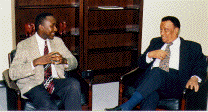 (USAfrica's founder Chido Nwangwu with Ambassador Carrington at the U.S. embassy, Nigeria) (USAfrica's founder Chido Nwangwu with Ambassador Carrington at the U.S. embassy, Nigeria)
DEMOCRACY'S WARRIOR
Out of Africa. …The cock that crows in the morning belongs to one household but his voice is the property of the neighborhood. -- Chinua Achebe, Anthills of the Savannah. An editor carries on his crusade against public corruption and press censorship in his native Nigeria and other African countries. By John Suval.
Johnnie Cochran will soon learn that defending Abacha's loot is not as simple as his O.J Simpson's case. By Chido Nwangwu
How Obasanjo handles Ige's murder will be telling. By Dr. Acho Emeruwa.
'We've killed Uncle Bola.' By Jonathan Elendu. Elendu is USAfricaonline.com contributing editor.
Why Ige's assassination demands better security for all. By Rev. Augustine Ogbunugwu.
HUMAN RIGHTS AND DEMOCRACY
How far, how deep will Nigeria's human rights commission go?
Rtd. Gen. Babangida trip as emissary for Nigeria's Obasanjo to Sudan raises curiosity, questions about what next in power play?
110 minutes with Hakeem Olajuwon
Nigerian stabbed to death in his bathroom in Houston.
Cheryl Mills' first class defense of Clinton and her detractors' game
It's wrong to stereotype Nigerians as Drug Dealers
Apple announces Titanium, "killer apps" and other ground-breaking products for 2001. iTunes makes a record 500,000 downloads.
Steve Jobs extends digital magic
|
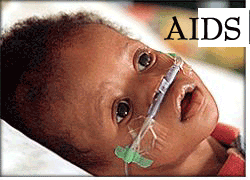
Africa suffers the scourge of the virus. This life and pain of Kgomotso Mahlangu, a five-month-old AIDS patient (above) in a hospital in the Kalafong township near Pretoria, South Africa, on October 26, 1999, brings a certain, frightening reality to the sweeping and devastating destruction of human beings who form the core of any definition of a country's future, its national security, actual and potential economic development and internal markets.
22 million Africans HIV-infected, ill with AIDS while African leaders ignore disaster-in-waiting
In a special report a few hours after the history-making nomination, USAfricaonline.com Founder and Publisher Chido Nwangwu places Powell within the trajectory of history and into his unfolding clout and relevance in an essay titled 'Why Colin Powell brings gravitas, credibility and star power to Bush presidency.'
Since 1958, Achebe's "Things Fall Apart" set a standard of artistic excellence, and more. By Douglas Killam.
Is Obasanjo ordained by God to rule Nigeria? and, other fallacies. By Prof. Sola Adeyeye
Obasanjo's outburst at Ikeja Bomb scene is wrong and unpresidential. By Emmy Ekjekam
Winnie Madikizela-Mandela's burden mounts with murder charges, trials
AFRICA AND THE U.S. ELECTIONS
Beyond U.S. electoral shenanigans, rewards and dynamics of a democratic republic hold lessons for African politics.
Why Bush should focus on dangers facing Nigeria's return to democracy and Obasanjo's slippery slide.
Obasanjo's own challenge to imbibe the basics of "democratic spirit and practice." By Prof. Ibiyinka Solarin
 CONTINENTAL AGENDA CONTINENTAL AGENDA
Bush's position on Africa is "ill-advised." The position stated by Republican presidential aspirant and Governor of Texas, George Bush where  he said that "Africa will not be an area of priority" in his presidency has been questioned by USAfricaonline.com Publisher Chido Nwangwu. He added that Bush's "pre-election position was neither validated by the economic exchanges nor geo-strategic interests of our two continents." he said that "Africa will not be an area of priority" in his presidency has been questioned by USAfricaonline.com Publisher Chido Nwangwu. He added that Bush's "pre-election position was neither validated by the economic exchanges nor geo-strategic interests of our two continents." These views were stated during an interview CNN's anchor Bernard Shaw and senior analyst Jeff Greenfield had with Mr. Nwangwu on Saturday November 18, 2000 during a special edition of 'Inside Politics 2000.'
Nwangwu, adviser to the Mayor of Houston (the 4th largest city in the U.S., and immigrant home to thousands of Africans) argued further that "the issues of the heritage interests of 35 million African-Americans in Africa, the volume and value of oil business between between the U.S and Nigeria and the horrendous AIDS crisis in Africa do not lend any basis for Governor Bush's ill-advised position which removes Africa from fair consideration" were he to be elected president.
By Al Johnson
Should Africa debates begin and end at The New York Times and The Washington Post? No |